
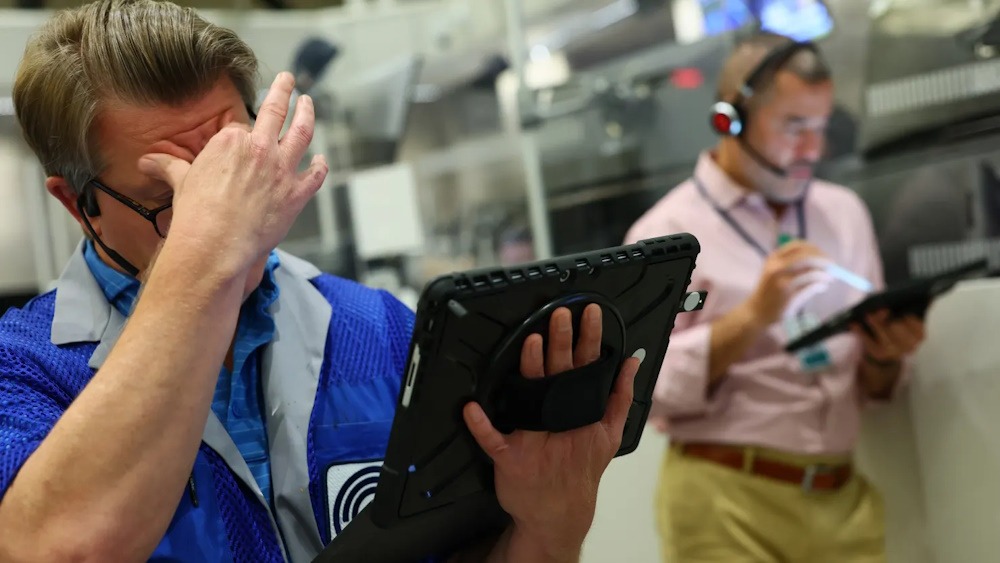
Markets remained cautious as thin holiday liquidity amplified the impact of technology-led declines, leaving futures largely flat while investors awaited guidance from the Federal Reserve’s policy minutes amid fading hopes for a Santa Claus rally. Profit-taking in high-performing tech stocks weighed on sentiment, even as U.S. equities stayed on course for strong annual gains, supported by expectations of future rate easing. Corporate developments highlighted softer momentum for Tesla, with delivery estimates pointing to a second consecutive annual decline, while Apple saw a rebound in iPhone shipments in China but continued market share pressure from rising competition and geopolitical risks. Asian markets traded mixed, reflecting subdued risk appetite and year-end positioning. Meanwhile, oil prices extended gains on renewed geopolitical tensions involving Russia, Ukraine, and the Middle East, alongside inventory concerns, underscoring persistent uncertainty around global growth, inflation, and supply dynamics heading into 2026.
As a result of a decrease on market, which was led by losses in the technology sector, index futures showed almost little change on Tuesday morning. When investors are waiting for fresh clues on the route that the Federal Reserve will take with its policies, they are navigating another holiday-shortened trading week in the midst of weak liquidity. Dow Jones Futures down 33 points to 48,716.0, while the S&P 500 Futures dropped 7 points to 6,948.0. The Nasdaq 100 Futures dropped 32 points to 25,707.75, while the Dow Jones Futures dropped 33 points to 48,716.0. Because markets are susceptible to year-end positioning and profit-taking, the movement was muted, which mirrored the lower participation that occurred in the days leading up to the New Year break. The leading technology companies had a pullback on Monday, marking the second consecutive session in which the market finished down. This came after a robust surge in December. There was a fall of around 0.5% in the S&P 500, Nasdaq Composite, and Dow Jones Industrial Average, all of which were recorded. Despite the fact that valuations remained high, investors reduced their exposure to top-performing technology stocks. This raises worries about whether or not the annual Santa Claus rally will completely materialize this year. Equities in the United States continue to be on track for high yearly gains, underpinned by prospects of further monetary easing, robust economic growth, and sturdy corporate profitability, despite the fact that conditions have recently become more favourable.
The minutes from the most recent policy meeting held by the Federal Reserve are scheduled to be made public later on Tuesday so that everyone may pay attention to them. The specifics will be scrutinized by investors in order to get insights into the judgments that policymakers have made on inflation, the state of the labor market, and the future path of interest rates. This is especially true given that markets continue to price in the possibility of easing in 2026. Due to the fact that economic data is scarce over the holiday season and that markets in the United States will be closed later this week for New Year’s Day, the minutes have the potential to play a significant role in defining the tone of the market in the short term.
Additionally, advancements in the corporate world continued to be a focal point, with Tesla and Apple taking the lead. The first time that Tesla has disclosed average analyst forecasts for car sales on its website, the company has revealed estimations that are behind the expectations of the broader market. Analysts anticipate that Tesla would deliver 422,850 vehicles during the fourth quarter, which would represent a 15% decrease from the previous year. Additionally, deliveries for the whole year are anticipated to be somewhere around 1.6 million, which would represent a second straight yearly dip. Despite lower delivery statistics, Tesla shares have continued to rise throughout the year, despite the fact that they have underperformed the S&P 500 as a whole.
In the meantime, according to statistics examined by Barclays, Apple’s iPhone shipments in China increased in November, despite the fact that market share continues to be under pressure. The arrival of the iPhone 17 was a major factor in the dramatic increase in shipments that occurred year-on-year; yet, Apple’s share of the Chinese smartphone market continues to lag behind that of previous years despite the increased competition, geopolitical dangers, and adverse macro environment. The Underweight rating that Barclays assigned to Apple was maintained because the company cited concerns over valuation, regulatory risks, and unclear growth prospects.
As a result of the overnight weakening and the limited liquidity at the end of the year, markets in Asia traded basically unchanged. Japan’s Nikkei and TOPIX both had little declines, while South Korea’s KOSPI remained relatively unchanged. On the other hand, Singapore, India, and Hong Kong all experienced increases. In a separate development, oil prices rose during trading in Europe, extending gains from the previous session. This was due to the fact that geopolitical tensions between Russia and Ukraine continued to remain, while threats from the Middle East became more apparent. The price of a barrel of Brent oil fell to $61.80, while the price of a barrel of WTI increased to $58.39. Investors were also considering delayed data on U.S. inventory levels, as well as following diplomatic developments and OPEC+ signals in advance of the beginning of 2026.