
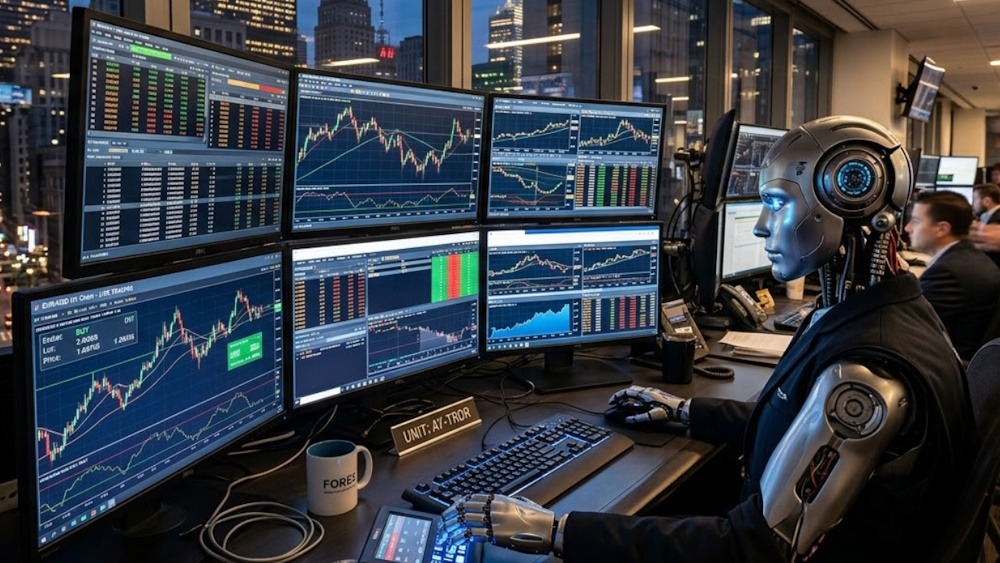
Automated trading systems – often colloquially called robots – are today a key part of the foreign exchange or forex market. Some $7 trillion is traded per day on these markets as of 2026, and automated systems account for the majority of that activity. Although forex robots have been used by financial institutions for decades now, it has only been in recent years that they have become accessible for retail traders at scale. So how did this situation emerge?
This article will look at exactly what forex trading robots offer and how they work, before explaining why those features translate to wide scale popularity and adoption. It will also look at the potential future of the market and the risks and limitations of the technology.
How They Work and What They Do
Forex trading robots analyse market data using predefined algorithms and then suggest or implement trades at lightning speed. They are usually connected to brokers automatically, or built within trading platforms that are.
Some robots operate on relatively simple algorithmic models that follow concrete and repeatable strategies, while more advanced trading robots can refine their own decisions and trades on the fly using machine learning.
Great robot trading forex systems offer market analysis, trade execution, risk management, strategy implementation, adaptative algorithms, data set updates and many other features. All in a single convenient, secure and easy-to-use package, that can be customized to traders’ preferences.
The data that trading robots assess is large and can vary depending on which robot a trader chooses. Some technical indicators modern trading robots can take into account include:
- Price patterns
- Volatility signals
- Support and resistance levels
- Trend strength indicators
- Moving averages
- Relative Strength Index
Some trading robots are based purely on historical “tick” data from global markets, which is then extrapolated to current market conditions. Other robots use a mix of historical and frequently updated recent data. Once a robot determines an effective trade, it can execute it in milliseconds or less – which is vitally important in many strategies.
Forex robots can also be used to automate specific strategies such as the Martingale, arbitrage or even trend following. This lets traders set up a bot to work with their preffered strategies and style of trading while not compromising on its advantages.
Why the Advantages are Driving Growth Right Now
Automated trading robots are not automated money printers, and that is not why they are popular. These systems are widely used because they’re incredibly more efficient than manual trading. Which can and should result in better trades.
Automation means traders can set up a trigger and let the bot place the trade at the appropriate time, without having to watch charts for hours. They can do this while traders are offline or asleep. Robots can also execute trades far faster than a human, and they aren’t influenced by emotional factors that can cause fractional delays in execution.
Even the tiniest amount of slippage can cost traders over long periods, and robots can reduce this cost to almost zero.
Wall Street firms and other global financial institutions have used these advantages for a long time. It’s only in recent years that the growth of retail trading has also spurred developers on to make automation more accessible.
Of course, smart readers would have noticed by now that all these upsides also come with risks to be aware of. That’s why top forex trading bots come with customizable risk management toolsets, allowing users to set a variety of limits and boundaries such as take-profit or stop-loss levels.
Traders Still Need to be Aware of Risks and Limitations
Even with built in tools for risk management, forex traders still need to learn how to use them and what they mean. Just because a strategy worked in one currency pair under certain conditions doesn’t mean its set and go across al markets.
To a certain extent, some bots can be deployed and left to their own devices. But they still need monitoring, because most trading bots can’t react to external market conditions.
During black swan global world events the value of currencies or commodities have been known to fall as much as 10% to 15% in a matter of hours. Although stop-loss levels and volatility drawdowns help to ameliorate risk if things do go wrong, its better to stop a losing trade before it loses at all. That’s why human monitoring of trading bots is important in most cases.
Technical issues are also worthy of considerations. Server outages and software errors can prove critical when executing trades needs speed and precision. Although not strictly necessary, many traders choose to run bots that can be hosted on dedicated VPS systems (virtual private servers) to ensure redundancy in case of failure. This also allows more access to custom performance data.
By combining trading bots with human oversight for regular technical evaluation and refining, traders can maximize the efficiency of their trading strategy while minimizing risk.