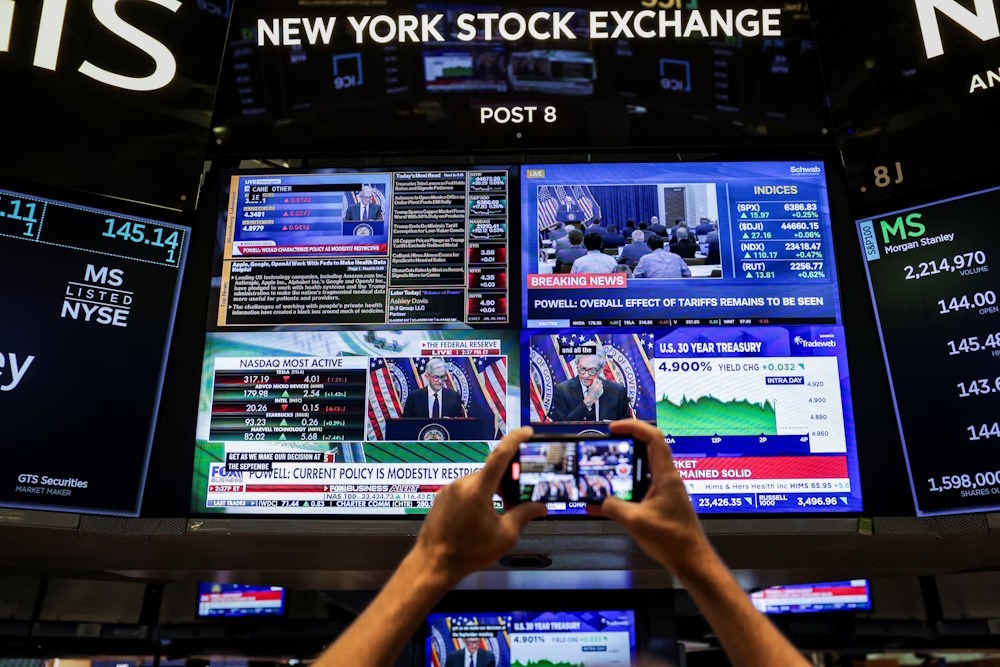
Dow Futures muted, as investors remain cautious amid conflicting signals regarding the status of peace negotiations between the U.S. and Iran. Hewlett Packard Enterprise has announced record results for the second quarter, advancing its long-term financial objectives by two years, driven by robust demand for artificial intelligence data centers. Meanwhile, Alphabet, the parent company of Google, has revealed a strategy to raise $80 billion in equity capital.
Dow futures indicated a predominantly downward trend on Tuesday, as persistent uncertainty shrouded the prospects for negotiations aimed at concluding hostilities in Iran. By 03:54, Dow futures had fallen by 60 points, or 0.1%, S&P 500 futures had dropped by 8 points, or 0.1%, and Nasdaq 100 futures had slipped by 39 points, or 0.1%. The primary indices on Wall Street concluded the previous session with modest gains, as equities experienced a rebound following U.S. President Donald Trump’s declaration that negotiations with Iran were progressing, despite earlier indications that Tehran had ceased sending mediated communications to Washington. Sentiment was bolstered by technology shares, which have been lifted by pervasive optimism regarding the expansion and potential of artificial intelligence. Claude-creator Anthropic has emerged as the latest firm to declare a substantial initial public offering, with a valuation approaching $1 trillion. Simultaneously, recent data suggests that the U.S. manufacturing sector has demonstrated considerable resilience despite the challenges posed by the conflict in Iran.
Lebanon has declared a partial ceasefire involving Iran-backed Hezbollah militants and Israel. However, reports indicate that Israel’s military intercepted two projectiles launched from Lebanon on Tuesday. President Trump stated that he believes a peace deal with Iran could be achieved within the next week. Trump asserted that there “was a little glitch” in the negotiations, presumably alluding to Iran’s objection to Israeli actions in Lebanon, which had allegedly prompted Tehran’s threat to withdraw from discussions. It remains uncertain if discussions between the U.S. and Iran have recommenced. Trump had previously stated that he was indifferent to Iran’s withdrawal from negotiations; however, he later asserted that discussions with Iran were “progressing rapidly.”
Brent crude futures, the global oil benchmark, experienced a decline in this context. By 04:13, the Brent oil contract had declined by 1.6% to $93.42 a barrel, remaining below recent highs exceeding $100 a barrel, while still surpassing pre-war levels. U.S. West Texas Intermediate crude futures experienced a decline of 1.4%, settling at $90.90 per barrel. Oil experienced a rally on Monday following reports from Iranian media indicating that Tehran had ceased communication with the U.S. via intermediaries. While the current status of negotiations is uncertain, it is evident that energy flows through the Strait of Hormuz have decreased significantly, reaching only a fraction of the levels observed prior to the onset of the conflict in late February. The closure of the narrow waterway off Iran’s southern coast has led to an increase in oil prices, raising concerns about a potential escalation in inflationary pressures.
Hewlett Packard Enterprise reported unprecedented results for the second quarter and advanced its long-term financial objectives by two years, driven by the growth of AI data centers that has increased demand for its servers and networking products. Shares surged by 36% in after-hours trading. HPE, a competitor of Dell and Super Micro Computer, announced a remarkable revenue growth of 40%, reaching $10.68 billion, surpassing analysts’ average estimate of $9.79 billion. The adjusted earnings per share of 79 cents exceeded Wall Street expectations of 53 cents. The company raised fiscal 2026 revenue growth outlook to between 29% and 33%, up from its prior expectations of 17% to 22%. It now anticipates annual revenue growth in the networking segment to range from 72% to 75%, marking a notable increase from the previous expectation of 68% to 73%.
Alphabet Inc. has announced an extensive strategy to secure $80 billion in equity capital, as the technology behemoth seeks to finance the soaring expenses associated with its AI infrastructure. The offerings comprise a $30 billion underwritten public offering, divided among depositary shares representing mandatory convertible preferred stock, Class A common stock, and Class C capital stock, alongside a $40 billion at-the-market offering anticipated to commence in the third quarter of 2026. Conglomerate has also consented to infuse $10 billion via a private placement. The extensive capital raise highlights the significant investment necessary to remain competitive in the generative AI landscape. Alphabet observed that the demand for its AI solutions from corporate enterprises and consumers is presently exceeding its available compute supply.