
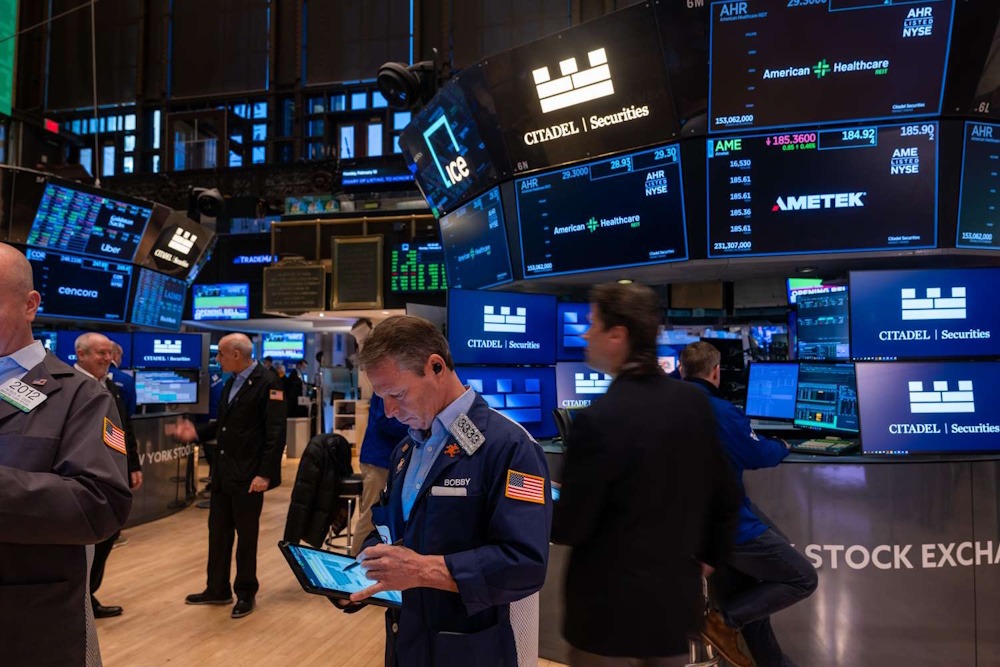
Dow Futures are showing a slight upward trend ahead of the commencement of the first complete trading week of the new year. move lower following the U.S. capture of major oil producer Venezuela’s leader, while shares of large U.S. energy firms gain in extended hours trading. The U.S. dollar gains support, as analysts work to discern the global implications of the U.S. incursion. In other developments, U.S. car sales are projected to increase in 2025, despite challenges posed by tariffs, supply chain disruptions, and the expiration of tax credits.
Dow Futures indicated a positive trajectory on Monday, as market participants monitored geopolitical events in Venezuela alongside forthcoming economic indicators. As of 02:46, the Dow futures contract exhibited minimal movement, whereas S&P 500 futures experienced an increase of 6 points, representing a 0.1% rise, and Nasdaq 100 futures advanced by 75 points, equating to a 0.3% gain. The benchmark S&P 500 and blue chip Dow Jones Industrial Average both recorded modest gains on Friday, as the inaugural session of 2026 was characterized by advancements in shares of semiconductor leaders Nvidia and Intel. Both indices ended their four-day losing streaks during this period. Analysts are keenly observing whether U.S. stocks can achieve another year of gains, following the substantial double-digit increases recorded by all three major averages on Wall Street in 2025. The S&P, Dow, and tech-heavy Nasdaq Composite have achieved their third consecutive year of positive performance, mirroring a similar streak observed from 2019 to 2021.
Crude prices experienced a significant decline on Monday following the bold U.S. apprehension of Venezuelan President Nicolas Maduro, which heightened expectations for increased supply from this key Latin American producer. Futures for March declined 0.8% to $60.27 a barrel by 03:08, while West Texas Intermediate crude futures decreased 0.9% to $56.82 a barrel. U.S. forces apprehended Maduro during a weekend operation, with the Venezuelan leader now poised to confront drug-trafficking allegations in New York. President Donald Trump stated that Washington will oversee Venezuela until a new leader is chosen, and that as part of this intervention, significant U.S. oil companies will be permitted to enter the country. Shares of oil groups, Chevron and ExxonMobil, all surged in extended hours trading. Venezuela possesses the largest proven oil reserves globally. However, the nation’s output has declined as a result of deteriorating infrastructure and stringent U.S. sanctions. Warren Patterson noted that remarks from Venezuelan Vice President Delcy Rodriguez advocating for collaboration between Venezuela and the U.S. imply the possibility of a “smooth transition” in the face of recent turmoil. Patterson argued that this would enhance the probability of the U.S. lifting its blockade on sanctioned oil tankers entering and leaving Venezuela, potentially exerting short-term downward pressure on oil prices. However, a “messier transition” could jeopardize approximately 900,000 barrels per day of oil supply from Venezuela, according to Patterson. Some upside risk may be present, although it is expected to be constrained in a market that is already characterized as “well-supplied,” according to Patterson.
Meanwhile, the U.S. dollar strengthened, alongside gold and the Swiss franc, with analysts suggesting that there has been “a modest flight to quality” in the wake of the weekend’s events in Venezuela. Significant discourse is currently focused on the ramifications of a prospective U.S.-initiated regime change in Venezuela, a factor contributing to the heightened attractiveness of “the liquidity of the dollar,” according to analysts. Trump has suggested the potential for a second military strike on Venezuela, contingent upon the interim administration’s cooperation with the United States. Trump indicated the possibility of taking action against Colombia regarding its involvement in the drug trade, and asserted that Cuba was on the verge of collapse. He reiterated his perspective that the U.S. must maintain control over Greenland for reasons pertaining to national security.
Bitcoin experienced an uptick, reflecting a wider ascent in technology equities, yet the overall advancements were tempered by a sense of caution following the U.S. military actions in Venezuela. This week’s attention is directed towards several significant economic indicators, with particular emphasis on the U.S. nonfarm payrolls data for December. Bitcoin experienced an increase of 1.1%, reaching a value of $92,264.5 by 01:33. The digital token experienced an uptick, correlating with advancements in technology equities, which it typically mirrors, as investor sentiment improved regarding the sector’s future, particularly in relation to artificial intelligence. Broader cryptocurrency prices also increased, reflecting this trend. However, the world’s largest cryptocurrency was experiencing a decline of 6.4% in 2025.
In 2025, new car sales in the U.S. experienced an approximate 2% increase, even in the face of challenges such as the conclusion of significant electric-vehicle tax credits, unpredictable shifts in U.S. tariff policy, and ongoing supply-chain disruptions. Analysts indicate that approximately 16 million vehicles were sold in the previous year, predominantly driven by combustion-engine trucks, SUVs, and hybrid alternatives. It is noteworthy that, although certain automakers increased the prices of vehicles manufactured outside the U.S., tariffs did not significantly affect the overall pricing of vehicles, according to a report. In December, average new-car retail transaction prices were projected to increase by a modest 1.5% compared to the same month in 2024, reaching $47,104. Analysts have indicated that persistent economic uncertainty and additional expenses associated with U.S. tariffs may jeopardize auto demand in 2026.