
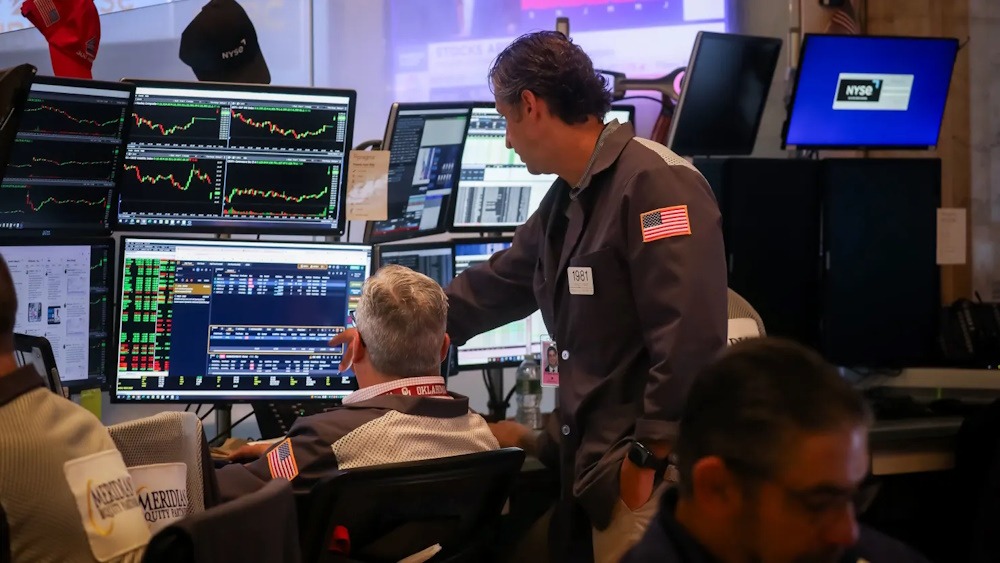
Dow Futures remain subdued as investors adopt a cautious stance ahead of the release of significant monthly employment data and a possible decision regarding the White House’s assertive import tariffs. President Donald Trump is scheduled to engage with oil industry executives as the United States considers asserting control over Venezuela’s substantial oil reserves, while also revisiting merger discussions with mining corporations.
Dow Futures remained largely unchanged on Friday, as investors exercised caution in anticipation of an important nonfarm payrolls report. By 02:54, the Dow futures contract remained largely stable, with futures showing minimal variation. The primary indices concluded the trading session on Thursday with a varied performance. The benchmark S&P 500 exhibited minimal movement, whereas the tech-centric Nasdaq Composite experienced a decline of 0.44%, and the blue-chip index recorded an increase of 0.55%. Defense stocks experienced a significant uptick, driven by President Trump’s proposal for a substantial escalation in military expenditure, projecting an increase to $1.5 trillion by 2027 from the $901 billion allocated by Congress for the current year. However, this was somewhat counterbalanced by a decrease in technology stocks, which indicated a persistent caution regarding the future returns from substantial investments in artificial intelligence. The S&P 500 technology index, which serves as a barometer for the sector, experienced a decline of 1.5%, primarily influenced by the performance of large-cap companies such as Microsoft and Nvidia.
Attention now turns to the forthcoming release of the December U.S. nonfarm payrolls report, which may provide insights into the labor market as the fourth quarter concludes. The U.S. economy is projected to have increased employment by approximately 66,000 positions in December 2025, a modest rise from the 64,000 recorded in November. The unemployment rate is projected to decrease to 4.5% from 4.6%.Analysts noted that the unemployment rate may be monitored even more than payrolls, reflecting the Federal Reserve’s emphasis on joblessness. Investors are paying close attention to job market data, as these figures could influence the future direction of Federal Reserve interest rate policy. The central bank reduced interest rates several times last year in an effort to support a faltering labor market, despite persistent signs of inflationary pressures. The analysts noted that other job numbers released this week have “sent conflicting U.S. macro signals.” A measure of private payrolls was deemed “acceptable,” yet a different assessment of job openings fell short of expectations, and overall job reductions in 2025 reached their highest level since 2020, they noted.
Meanwhile, the U.S. Supreme Court is expected to possibly issue a ruling regarding the legality of President Trump’s extensive tariffs today, although this outcome is not assured. The matter at hand concerns Trump’s invocation of emergency economic powers established by a 1977 statute to implement the tariffs. During hearings in November, justices from both conservative and liberal backgrounds expressed skepticism regarding Trump’s assertions. Recent statements on tariffs by Trump indicate that the White House is preparing for an unfavorable outcome, the analysts observed. Polymarket, the online betting platform, currently indicates a probability of one in four that the Supreme Court will decide in favor of Trump. Should the tariffs be reversed, some observers have indicated that a fresh wave of uncertainty could envelop what has been an unpredictable trade agenda. A significant inquiry pertains to whether a judgment unfavorable to the Trump administration would compel the U.S. government to disburse approximately $150 billion in refunds for tariffs previously remitted by importers. Some analysts propose that the White House could respond to an unfavorable result by exploring alternative legal pathways to reinstate the tariffs.
In Washington, President Trump announced plans to convene with executives from several major oil companies on Friday to deliberate on the future of Venezuela’s extensive oil reserves. In a recent interview, Trump stated that the “top 14 companies are coming” to the White House, tasked with the objective of “rebuild[ing]” Venezuela’s depleted oil infrastructure. Media reports indicated that it remains uncertain which firms will participate in the event. Reports indicate that the Trump administration has extended invitations to the leaders of commodity trading firms Vitol and Trafigura for discussions. Trump aims to exert control over Venezuelan oil, potentially for the long term, following a military operation by U.S. forces last weekend that led to the apprehension of the country’s longstanding leader, Nicolas Maduro. Earlier this week, Trump stated that Caracas had consented to deliver up to 50 million barrels of oil to the U.S. However, reports indicate that oil companies are seeking “serious guarantees” prior to committing substantial investments in Venezuela.
Rio Tinto shares declined in London following the announcement that the mining giant has resumed merger discussions with Glencore. Glencore experienced a notable increase of 6.7% in London trading by 03:37. The resumption of discussions was initially disclosed by The Financial Times. Glencore subsequently affirmed in a statement that it is engaged in “preliminary discussions with Rio Tinto” regarding a potential combination of some or all of their operations, which may encompass an all-share merger between the entities. “This agreement presents a mutually beneficial opportunity for both entities, supplying Rio with the necessary copper and reducing its iron ore exposure, while simultaneously creating value for Glencore shareholders,” Ben Davis remarked in a note.