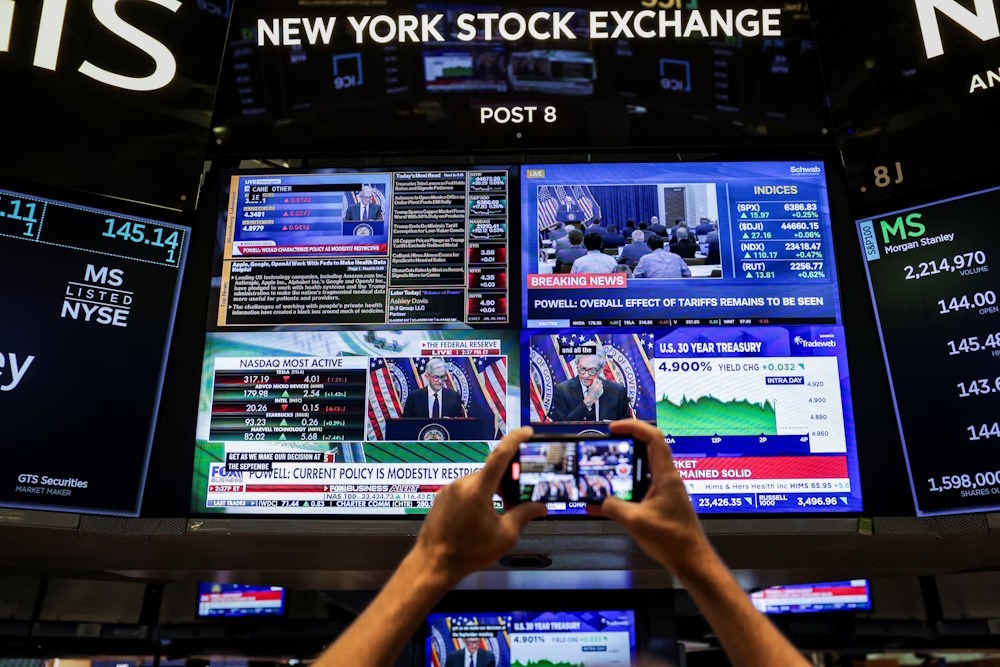
Dow futures are showing a slight increase as the market anticipates a week filled with significant economic data releases and important addresses from leading central bankers. Much of the attention is directed towards the Middle East, where reports indicate that the U.S. and Iran have reached an agreement to cease several days of strikes in the Strait of Hormuz.
Dow futures on Wall Street indicated an upward trajectory on Monday, as investors assessed reports regarding a cessation of the ongoing strikes between the U.S. and Iran, coinciding with the commencement of a holiday-shortened trading week. By 03:11, the Dow futures contract had risen by 107 points, or 0.2%, S&P 500 futures had gained 36 points, or 0.5%, and Nasdaq 100 futures had climbed by 223 points, or 0.8%. The averages all edged lower to end the prior week, influenced in part by reports of a potential delay in a highly anticipated initial public offering from ChatGPT-maker OpenAI. This development raised concerns regarding artificial intelligence and data center stocks that have profited from a significant surge in capital expenditures on AI infrastructure. “The deterioration in sentiment around AI has certainly weighed on the Nasdaq and capitalization-weight S&P, but by diminishing the stranglehold this industry has had on markets, money is being liberated to shift into more neglected areas,” analysts said in a note.
The U.S. and Iran have reached an agreement to cease the recent cycle of retaliatory strikes in the Strait of Hormuz, thereby facilitating increased shipping activity in this critical maritime corridor, as reported by various sources. Citing U.S. officials and other countries involved in peace talks between Washington and Tehran, sources reported that both sides will resume negotiations that have been jeopardised by the attacks. Some officials have indicated that the U.S. proposed to conduct discussions with Iran in the Qatari capital of Doha, as reported by the source, noting that the specifics of the summit remain to be finalised. The strikes erupted on Thursday, causing a slowdown in traffic in the Strait of Hormuz, which had previously exhibited signs of recovery following an agreement earlier this month to extend a ceasefire and engage in negotiations regarding Iran’s nuclear program. The strait serves as a vital passage for approximately one-fifth of the global supply of oil and liquefied natural gas, raising concerns that its prolonged closure during the coordinated U.S.-Israeli offensive against Iran could hinder economic growth worldwide.
Oil prices fluctuated near the equilibrium point, as traders maintained a vigilant watch on the prospects for tanker operations in the Strait of Hormuz. Brent crude futures, the benchmark for world oil, were last higher by 0.5% at $72.32 a barrel, while U.S. West Texas Intermediate crude futures rose by 1.0% to $69.91 a barrel. “The oil market has seen only modest gains this morning despite the re-escalation between the U.S. and Iran […],” analysts noted in a communication to clients. “Even so, we continue to believe the market is too optimistic about the timeline for a recovery in Persian Gulf supplies.”
Elsewhere, a packed schedule of economic events this week is set to commence with a keynote address from European Central Bank President Christine Lagarde at a significant conference in Portugal. The ECB’s Sintra conference, which serves as a parallel to the Federal Reserve’s Jackson Hole gathering, will include a panel on Wednesday featuring new Fed Chair Kevin Warsh. Policymakers have been engaged in deliberations regarding the appropriate calibration of monetary policy in light of concerns over an inflationary surge stemming from the Iran war. Despite oil prices having reverted to levels seen prior to the conflict, the ramifications of a recent sharp increase in crude costs continue to be shrouded in uncertainty. Consequently, considerable discussion has emerged regarding the likelihood of central banks choosing to increase interest rates, as evidenced by the actions of the ECB and Bank of Japan, or maintaining their current stance, as seen with the Fed and Bank of England.
Providing a backdrop for the Sintra event will be a collection of fresh data tracking various economic indicators, including inflation in the Eurozone and the U.S. jobs market. On Wednesday, preliminary consumer price data for June from the 21-member Eurozone currency area will be released, with forecasts indicating that the figure has moderated to 3.0% from 3.2% in the twelve months to June. Excluding volatile components such as food and fuel, the “core” CPI measure is projected to match May’s annualised rate of 2.6%. The U.S. employment report for June will prominently feature on the economic calendar this Thursday. Nonfarm payrolls are projected to reach 114,000 in June, a decrease from the 172,000 recorded in the preceding month. The unemployment rate is projected to remain at 4.3%, consistent with the figure recorded in May. In the lead-up to the NFPs, the prevailing sentiment will be influenced by consumer confidence, job openings, private payrolls, and data pertaining to manufacturing sector activity. “Ultimately, the key directional catalyst will be June’s payrolls,” the analysts said in a note.