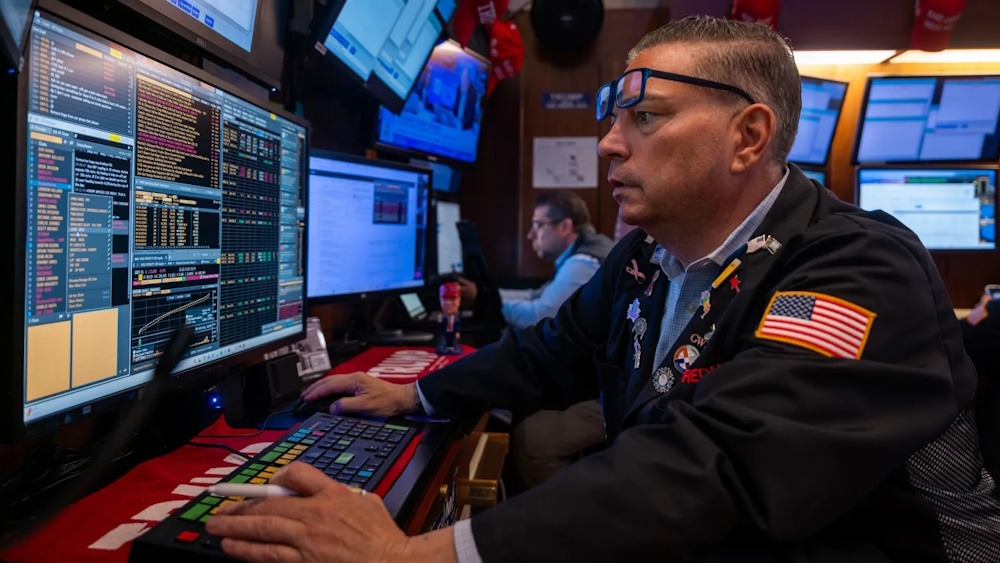
Dow Futures fluctuate slightly above and below the neutral point, as market participants anticipate critical inflation data and evaluate the tenuous sentiment surrounding the artificial intelligence sector. Oil has declined to approximately $90 a barrel amid optimism for a diplomatic resolution to the conflict in Iran, while Nvidia shares have experienced a slight increase in after-hours trading following a selloff on Monday that was instigated by a scandal involving CEO Jensen Huang.
Dow futures indicated a varied opening on Tuesday. By 03:17, the S&P 500 futures contract had increased by 13 points, or 0.2%, whereas Nasdaq 100 futures had decreased by 22 points, or 0.1%. The Dow futures contract increased by 252 points, or 0.5%. The primary indices on Wall Street experienced an uptick in the previous session, driven by a resurgence in dip-buying that propelled the benchmark S&P 500 to its most significant daily increase since April. Optimism has once again surged regarding AI, following the recent volatility in stocks associated with this emerging technology. Notably, a tracker of the semiconductor industry recorded its most significant one-day gain since July. Following a series of selloffs and recoveries, the index is now down “only” 0.25% in the four business days after the U.S. midterm elections, analysts at Deutsche Bank noted. Traders are assessing the implications of a significant Democratic victory, particularly in gubernatorial contests within states that are home to substantial data center initiatives, and its potential impact on the pace of AI development. “There wasn’t an obvious catalyst for the bounceback, but as our equity strategists noted, equity positioning had become sizably underweight after last week’s moves, and in tech, positioning was now beneath its lows after Liberation Day,” the analysts said.
Attention now shifts to the forthcoming release of monthly U.S. inflation data. Headline consumer prices are projected to have increased by 0.3% on a month-over-month basis in October. The annualised rate will not be released due to a federal government shutdown last year, which hindered the collection of the consumer-price index for October 2025. The “core” gauge, which excludes volatile items such as food and fuel, is anticipated to rise by 0.2% on a month-over-month basis. Energy remains the “principal swing factor” for overall price gains, as noted by analysts at Truflation, an alternative data provider. For October, Truflation has projected a 20.7% increase in energy prices compared to the same period last year, with petrol prices surging by 37.7%. Increased expenses at the petrol station contributed to widespread dissatisfaction regarding affordability, which played a significant role in the strong criticism of U.S. President Donald Trump’s economic policy during the midterm elections. American voters demonstrated substantial backing for Democratic challengers to Trump’s Republican candidates across various statewide contests, resulting in Democrats gaining control of both chambers of Congress. The victory may complicate Trump’s ability to vigorously advance his policy objectives, such as the ongoing conflict with Iran and the imposition of tariffs on international trading partners. Crucially, the outcome of the Labour Department’s consumer-price index could influence projections for Federal Reserve interest rates. Robust labour market data released last Friday could provide Federal Reserve officials with greater latitude to implement an interest rate hike next month, following the initial increase in three years that was introduced in September. In theory, increasing borrowing costs can suppress inflation, though this comes with the potential downside of impacting overall economic activity and the labour market.
Additionally supporting equities has been a decline in oil prices, which has pulled the benchmark Brent crude futures contract down to approximately $90 a barrel. As recently as late October, Brent was trading at over $115 a barrel, as markets expressed concern over the potential for renewed and intensified U.S. military actions against Iran following the midterm elections. However, diplomatic efforts seem to be gaining momentum. Trump has indicated a desire to seek a resolution to the ongoing conflict with Iran, which has now persisted for nine months and has contributed to rising energy prices and heightened inflationary pressures. The president’s remarks followed a meeting with the prime minister of Qatar, who often plays the role of mediator between Washington and Tehran. Trump cautioned that the U.S. is “locked and loaded,” while characterising Iran’s military as “effectively over.” Citing an official familiar with the matter, source reported that discussions between the U.S. and Iran will continue, and it is unlikely that there will be a new military escalation.
In other developments, Nvidia’s shares experienced a slight uptick in after-hours trading, following a decline of over 4% after the company disclosed an independent investigation concerning CEO Jensen Huang. In a memo to employees, Huang acknowledged engaging in a romantic relationship with a businesswoman from a Singapore-based firm, who was reportedly a spy for China. The news has unsettled Nvidia, which has emerged as a bellwether and a regular financial backstop for the AI industry under Huang’s leadership. Speaking to reporters during a press briefing at the White House, Trump said “I know the FBI is looking into [Huang] and I think that he’ll be in good shape.” And “I asked him that question. Did you have any idea that she was a spy? He said I had no idea that she was a spy and I really believe him,” Trump said.
Anthropic may commence formal marketing of its potential blockbuster initial public offering on Tuesday, providing the Claude-maker with the opportunity to present itself as a robust investment amidst the wider disruptions in the AI sector. The company reportedly communicated to bankers the details of the IPO prior to retracting the pricing information, asserting that the figures were inaccurate, as reported on Monday, referencing emails reviewed by the news agency. Anthropic initially circulated a copy of an IPO filing indicating plans to offer approximately 867 million shares at a price range of $70 to $80 each, potentially raising as much as $69.3 billion. However, it subsequently communicated to bankers that the pricing details were incorrect and that a revised filing would be issued at a later time, as reported by source.