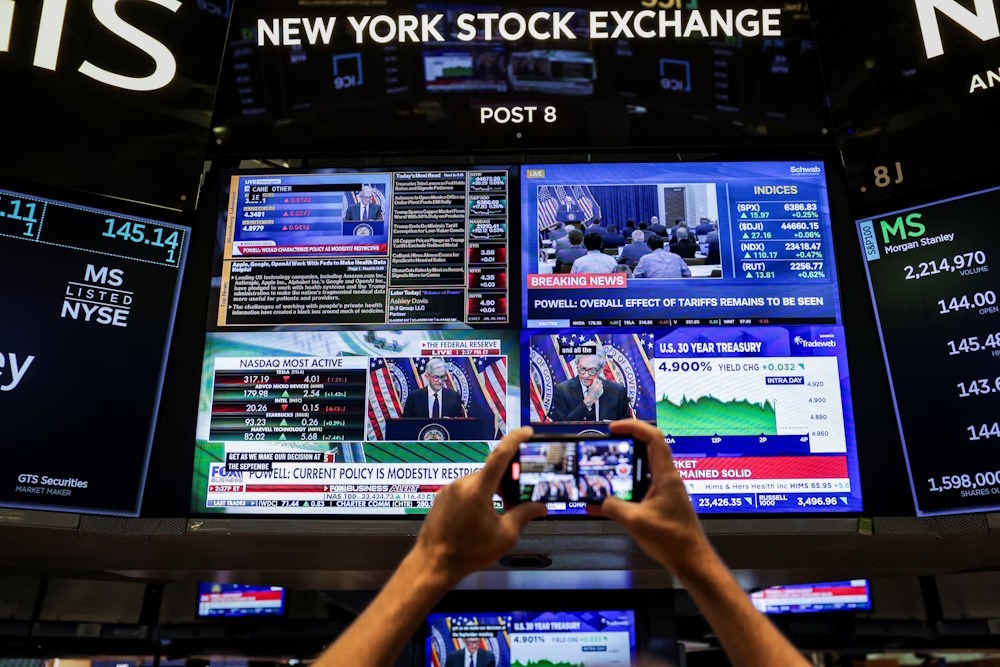
Dow Futures remain near the flatline, reflecting a chip-driven decline in equities from the prior session. Investors are anticipating the forthcoming release of the minutes from the Federal Reserve’s July policy meeting, keen to glean insights into the trajectory of the central bank’s interest rate decisions. Target is set to be one of the recent entrants from the U.S. retail sector to disclose its quarterly earnings, coinciding with the U.S. decision to suspend a proposed 50% tariff on Canada.
Dow futures exhibited a subdued response on Wednesday, following a pronounced selloff in semiconductor stocks and an increase in government bond yields that impacted equities. By 03:11, the Dow futures contract had increased by 42 points, or 0.1%, while S&P 500 futures remained largely stable, and Nasdaq 100 futures experienced a decline of 40 points, or 0.1%. The primary indices on Wall Street experienced a decline on Tuesday, as analysts at Vital Knowledge indicated that the lacklustre performance in semiconductor stocks was influenced by a combination of profit-taking and concerns regarding a “tidal wave” of debt issuance associated with the artificial intelligence surge. Concerns have persistently emerged regarding the sustainability of substantial investments in AI infrastructure, especially concerning the advanced data centers essential for supporting this burgeoning technology. Concerns regarding fiscal deficits and escalating oil prices, exacerbated by the persistent deadlock in the Iran conflict, have led to a significant increase in bond yields globally, reaching new highs, according to analysts at Deutsche Bank. However, U.S. Treasury yields retreated from these peaks after a disappointing set of U.S. data on housing and industrial production, raising concerns about the pace at which the Federal Reserve might increase interest rates.
Bets on a potential increase in the Fed’s interest rate in the near future have diminished following the release of recent lacklustre labour market data and subdued inflation figures. These wagers may undergo further scrutiny on Wednesday, as the Fed is set to publish the minutes from its July policy meeting. At the gathering, the Fed maintained its stance on rates, yet bond markets experienced volatility following the decision as participants deliberated over remarks made by Fed Chair Kevin Warsh. In a manner consistent with his brief time leading the central bank, Warsh provided traders with no insights regarding forthcoming interest rate strategies, merely stating that the Fed will “not waver” in its dedication to reducing inflation to its 2% target. In the absence of forward guidance, investors are expected to rely on the minutes to piece together a tentative understanding of the Federal Reserve’s potential actions in the upcoming months. Warsh characterised the meeting as a “good family fight,” highlighting that three members opposed the decision to maintain the rate, advocating instead for a 25-basis point increase.
On the earnings calendar, traders will be monitoring a series of retail sector returns, which may provide insights into the condition of American consumers facing wider economic uncertainty. Target is set to be one of the prominent companies to announce its earnings prior to the market opening. The big-box retail chain raised its annual sales growth forecast for the first time in two years in May, despite cautioning about a challenging macroeconomic environment. CEO Michael Fiddelke remarked that although he was satisfied with the company’s first-quarter sales growth of 5.6%, he would not “confuse this progress with potential.” Meanwhile, the home improvement items retailer Lowe’s is set to release its results. On Tuesday, rival Home Depot notched better-than-expected second-quarter sales and profit, as demand for repair and maintenance helped to mitigate the impact of subdued spending on large renovation projects. Beyond retail, chipmaker Analog Devices will be in focus as well. In May, the group’s third-quarter revenue forecast exceeded estimates, in a sign that the AI era is powering demand for its semiconductors and sensor components.
President Donald Trump has said he would temporarily halt a planned 50% tariff on a range of Canadian goods for three days, allowing time for the two traditionally close trading partners to forge a new agreement. Writing just hours before the deadline for the fresh levies to take effect, Trump said in a social media post that the U.S. and Canada have a “deal,” subject to “the finalization of documents.” Invoking a Depression-era law designed to punish countries who have allegedly discriminated against U.S. products, the Trump administration threatened in July to slap the tariffs on around $20 billion worth of Canadian products, including wine, furniture, fishing rods, and hockey sticks. The Office of the U.S. Trade Representative said the deal with Ottawa would include improved access to Canadian markets for American products as well as “alignment” on digital trade matters. Canadian Prime Minister Mark Carney, for his part, said there had been progress in discussions with the White House, but flagged that “important work” still needs to be done. Carney stressed that he remains committed to building a Canadian economy that is “more independent” and “competitive”.
OpenAI’s revenue grew 18% in the second quarter, but losses widened further as the ChatGPT-maker struggled to match the pace of rival Anthropic, source reported. OpenAI informed investors that revenue amounted to $6.7 billion in the quarter ending in June, an increase from $5.7 billion in the preceding quarter. The 18% quarter-on-quarter increase fell short of expectations for some investors who had anticipated the company would demonstrate more rapid advancement in comparison to Anthropic. Anthropic, in contrast, more than doubled its revenue to $11.6 billion during the same timeframe, exceeding OpenAI for the first time, while also achieving a modest operating profit, as indicated in the report. The divergence underscores a potential transformation in the competitive landscape of artificial intelligence. OpenAI has encountered a deceleration in the growth of ChatGPT, coinciding with the increasing adoption of Anthropic’s Claude Code product among developers. The source indicated that this combination has heightened pressure on OpenAI to modify its strategy and expedite growth.