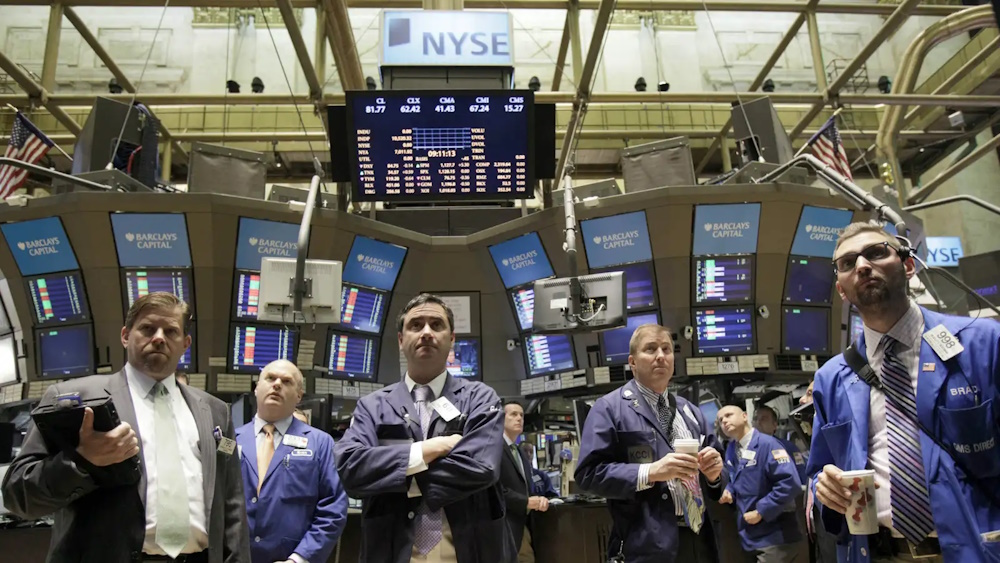
Dow Futures experience a slight increase, yet investors remain cautious amid a significant selloff in the bond market this week. The U.S. 10-year Treasury yield reaches its highest level since 2007, driven by a confluence of high oil prices, robust U.S. economic performance, and speculation regarding the Federal Reserve’s interest rate path. In other developments, Costco has reported fiscal fourth-quarter results that exceed expectations.
Dow futures indicated an upward trajectory on Friday; however, an increase in Treasury yields exerted pressure on risk assets as the market approached the final trading session of the week. By 03:12, the Dow futures contract had increased by 63 points, representing a 0.1% rise, while S&P 500 futures had progressed by 11 points, also a 0.1% gain, and Nasdaq 100 futures had moved up by 126 points, reflecting a 0.4% increase. The primary indices on Wall Street concluded Thursday with a varied performance, as the blue-chip Dow Jones Industrial Average and the benchmark S&P 500 experienced declines, whereas the tech-oriented Nasdaq Composite achieved a slight increase of 0.01%. “One important theme at the moment is that Treasuries continue to sell-off with oil but that breakevens aren’t moving, with pretty much all the move being driven by real yields,” analysts said in a note.
The recent selloff in global debt has negatively impacted equity-market sentiment since Wednesday. Fuelled by the dual influences of high oil prices and indications of U.S. economic strength, expectations have risen that the Federal Reserve may have greater latitude to increase interest rates in the latter part of this year. Last week, the Fed raised rates by a quarter of a percentage point, citing the necessity to address inflation driven by energy costs. These wagers on the Fed’s rate path propelled a surge in the benchmark 10-year U.S. Treasury yield to a post-2007 peak of 5.2% by the close of trading on Thursday, and elevated the longer-dated 30-year yield to its highest level since 2004. The 10-year yield, in particular, recorded its most significant two-day increase since President Donald Trump implemented his extensive “Liberation Day” tariffs last year. A pattern has recently emerged in which a rise in oil prices pushes bond yields higher and stocks down, although some observers have questioned the economic logic of oil dictating long-term interest rates.
Oil prices declined on Friday following reports that the U.S. and Iran were considering a phased agreement to reopen the Strait of Hormuz, which alleviated some supply concerns. However, a missile attack by Houthi forces on Saudi Arabia maintained heightened geopolitical risks. Both benchmarks had risen by as much as 5% during the preceding session before retracting some of those gains following reports concerning the U.S.-Iran discussions. Gains on Thursday followed the announcement from Saudi Arabia regarding the interception of six ballistic missiles launched by Yemen’s Iran-backed Houthis, targeting regions such as Taif and the Yanbu area along the Red Sea. The attacks have reignited apprehensions regarding the integrity of Saudi oil infrastructure and its export pathways, especially following previous damage to the kingdom’s East-West pipeline, which had already interrupted crude shipments to Yanbu. The security risks are particularly pronounced given that Yanbu serves as a crucial export hub on the Red Sea, linked to the eastern oil fields of Saudi Arabia. Saudi Arabia has been augmenting crude oil production directed toward Yanbu; however, tanker loadings from the port have not yet completely returned to normal operations. The rally was tempered following reports indicating that U.S. and Iranian negotiators in New York are considering a phased approach to resolving the conflict, which would entail Tehran reopening the Strait of Hormuz in return for Washington lifting its economic blockade of Iran.
Elon Musk stated his intention to approximately double the quantity of advanced Nvidia chips utilised by the Colossus 2 data center by year-end. In a recent post on X, Musk indicated that the Tennessee-based center has utilised 110,000 of Nvidia’s GB200 chips and 440,000 of Nvidia’s GB300 chips. The CEO of SpaceX announced that an additional 220,000 GB300 chips are expected to become operational by next week, with another 220,000 scheduled for November. “If we get lucky, yet another 220k GB300 by late December,” Musk said in response to a post on xAI’s computing capacity. Musk has touted the Colossus center as the “world’s largest AI supercomputer,” with Colossus 1 having been initially built in 2024 to train xAI’s flagship AI Grok.
Costco reported fourth-quarter results that exceeded Wall Street’s expectations for both revenue and earnings. However, shares of the members-only warehouse chain experienced a slight decline in after-hours trading on Friday. Earnings per share of $6.75 exceeded the consensus estimate of $6.55 by $0.20. Revenue reached $95.7 billion, exceeding the analyst estimate of $94.85 billion. Net sales for the 16-week fourth quarter rose by 11.2%, reaching $93.9 billion compared to $84.4 billion in the same period last year. The company’s adjusted EPS of $6.75 incorporated a non-recurring benefit of $0.15 per share from tariff refunds received during the quarter, after accounting for the partial reinvestment of those refunds into enhanced member values. Comparable sales for the fourth quarter rose by 9.4% on a reported basis and by 6.7% when adjusting for the effects of fluctuations in petrol prices and foreign exchange, surpassing the analyst estimate of 6.44%. U.S. comparable sales increased by 10.7% when reported and by 7.2% when adjusted. Canada’s comparable sales rose by 5.0%, or 4.6% when adjusted, whereas Other International markets experienced a growth of 7.0%, or 6.2% adjusted.