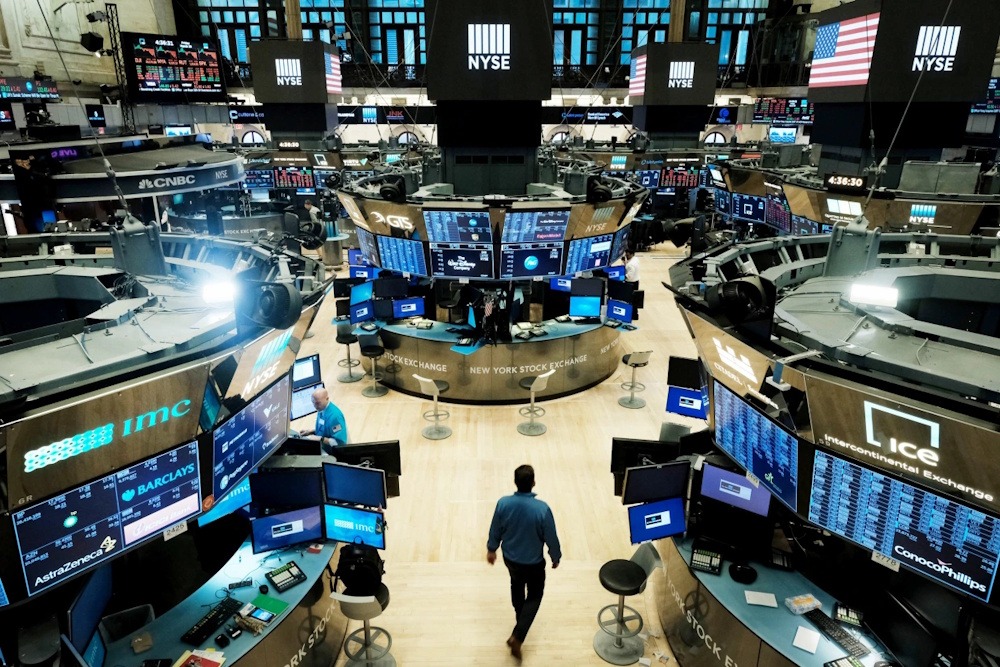
US Markets exhibited caution on Friday as renewed U.S.-Iran clashes near the Strait of Hormuz led to a decline in global equities. “Markets still aren’t pricing in the worst-case scenario,” Deutsche Bank strategists led by Henry Allen noted in their morning communication to clients. Investors considered President Donald Trump’s forthcoming summit with China, alongside a series of volatile software earnings results that prompted significant premarket fluctuations throughout the tech sector. Later today, we will receive additional information with the release of the U.S. jobs report for April.
Oil prices experienced a decline on Friday following an initial surge caused by renewed hostilities between U.S. and Iranian forces in proximity to the Strait of Hormuz. briefly surged as much as 3% in Asian trading before retracting all gains to trade below the $100 mark once more. The recent flare-up has unsettled markets, occurring just days after Washington and Tehran indicated that a more comprehensive peace framework might be within reach. President Donald Trump asserted that the ceasefire, which has been in place for a month, continues to hold despite recent exchanges of fire. Despite the volatility observed on Friday, crude oil is still positioned for an approximate 7% decline over the week, fueled by hopes that diplomacy may ultimately succeed.
Geopolitics continued to take precedence as Trump prepares for his upcoming summit with Chinese President Xi Jinping next week in Beijing. The meeting would signify the first U.S. presidential visit to China since 2017 and occurs at a particularly delicate time for global markets. Discussions are anticipated to center significantly on the Iran conflict, trade tensions, and economic coordination. Reports indicate that the U.S. business delegation accompanying Trump could be smaller than those dispatched by other nations in recent months. Investors are closely monitoring developments regarding a possible upcoming visit by Xi to the United States.
Asian equities declined following Wall Street’s pullback from its record highs overnight. The Japanese and South Korean markets experienced a decline from their recent highs as escalating tensions in the Middle East dampened investor appetite for risk. Japan’s market closed 0.2% lower, while South Korea’s market erased early losses to finish modestly higher on the day. Europe followed suit, declining by as much as 0.9% in early trade. The vulnerability emerged following the announcement from the U.S. military that it had intercepted assaults aimed at three warships in the vicinity of the Strait of Hormuz. On a more positive note, U.S. futures are showing moderate gains today, with the S&P 500 futures trading approximately 0.3% higher in anticipation of the NFP report.
Investors are poised to scrutinize Friday’s U.S. jobs report for additional insights into the economy and the trajectory of the Federal Reserve’s policy. Last month’s payrolls figure reached a notable 15-month high of 178,000. “That’s an important one, as Fed pricing has already shifted in a hawkish direction given the energy shock,” Allen stated. Economists now anticipate that April payrolls will increase by 50,000, representing the first consecutive positive reading since May of the previous year, while the unemployment rate is projected to remain unchanged at 4.3%.
Software earnings generated significant stock movements as Friday’s session approached. surged nearly 30% in premarket trading following the announcement of a $1.8 billion long-term cloud agreement associated with a frontier AI model provider. Increased by 12% following the announcement of quarterly revenue and profit that surpassed expectations, bolstered by enhanced transaction and subscriber fees. Other software names experienced a significant downturn, with all posting double-digit declines following their results.