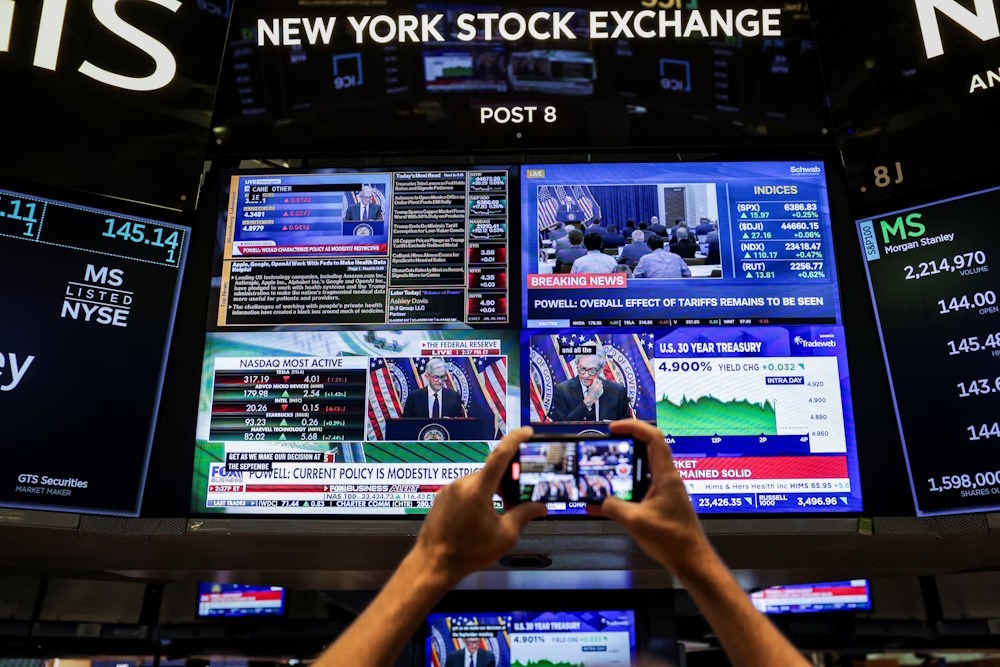
Dow Futures hover near the neutral point, as traders closely monitor developments regarding potential advancements in negotiations aimed at resolving the conflict in Iran. Oil prices are poised for a weekly decline, indicative of growing optimism regarding a potential agreement between the U.S. and Iran in the near future. Elsewhere, new information surfaces regarding what appear to be significant public offerings anticipated later this year.
Dow futures displayed a subdued performance on Friday, as investors carefully monitored reports indicating that the U.S. and Iran had come to an agreement to prolong their ceasefire, awaiting President Donald Trump’s endorsement. By 03:42, the futures were mostly unchanged, while had edged down by 0.1%. The primary indices on Wall Street experienced an uptick on Thursday, driven by positive sentiment stemming from a series of favourable earnings reports, an inflation figure that came in below expectations, and optimism surrounding a potential resolution to the conflict in Iran. “We still think an Iran deal is widely expected and so the reaction in the SPX when one arrives shouldn’t be dramatic at this point, although oil and yields have room to fall, and could have a more pronounced response to an accord,” analysts noted.
The U.S. and Iran are reported to have reached an agreement to prolong their weeks-long ceasefire, awaiting approval from President Donald Trump. Sources indicate that the agreement would prolong the ceasefire by 60 days. It would also facilitate the resumption of shipping activity through the Strait of Hormuz while negotiators work through the specifics of a broader agreement, encompassing matters related to Iran’s nuclear aspirations. The Strait of Hormuz, a crucial maritime corridor facilitating the passage of approximately one-fifth of global oil supplies, has emerged as a significant point of contention in the ongoing conflict in Iran, which has persisted for nearly three months. Both parties have taken steps to limit commercial vessel traffic through the conduit, constraining global energy supplies and resulting in a significant increase in oil prices.
Brent crude futures, the global oil benchmark, were last hovering around the flatline at $93.87 a barrel, while U.S. West Texas Intermediate crude futures had slid by 0.2% to $88.72 a barrel. Oil futures are currently set to record their most significant weekly decline since early April. However, despite easing from peaks above $100 a barrel, Brent oil remains significantly elevated compared to pre-conflict levels. Concerns have emerged that a wave of inflation driven by energy prices will ultimately impact nations globally, including the United States. “The Federal Reserve’s preferred inflation metric on Thursday indicated that prices increased at a slower-than-anticipated rate in April. However, there were indications that consumer spending power was being affected, as households curtailed expenditures to counterbalance escalating energy costs. The Fed is unlikely to cut rates again anytime soon and will likely retain a hawkish bias over the summer months, until policymakers are confident that the energy surge has passed and will start to reverse,” analysts said in a note. “However, that necessitates an agreement to re-open the Strait of Hormuz.”
Beyond the conflict, focus shifted to the valuations of highly anticipated potential initial public offerings later this year, with some projected to be substantial in scale. On Thursday, the focus was on Anthropic. The AI start-up disclosed that it secured $65 billion in Series H funding, achieving a post-money valuation of $965 billion. The funding round was spearheaded by Altimeter Capital, Dragoneer, Greenoaks, and Sequoia Capital, with co-leadership from Capital Group, Coatue, D1 Capital Partners, GIC, ICONIQ, and XN. Anthropic’s run-rate revenue surpassed $47 billion earlier this month, as noted by Krishna Rao. The company reported that adoption has increased among global enterprise customers since its Series G funding round in February. The funding will enhance safety and interpretability research, increase computational capacity to satisfy demand for Claude, and scale products and partnerships, the company stated. Anthropic has expanded its compute capacity in recent weeks, signing agreements with Amazon for up to five gigawatts of new capacity, with Google and Broadcom for five gigawatts of next-generation TPU capacity, and with SpaceX for access to GPU capacity in Colossus 1 and Colossus 2. Claude, the designation for Anthropic’s widely recognised large-language model, is accessible on Amazon Web Services, Google Cloud, and Microsoft Azure, with AWS continuing to serve as Anthropic’s principal cloud provider and training collaborator.
Elon Musk’s SpaceX is aiming for a valuation of at least $1.8 trillion in its forthcoming initial public offering. This figure is lower than previous internal targets but still positions the company to potentially achieve the largest IPO in history, according to Bloomberg News, which cited sources familiar with the matter. The report indicated that the rocket and artificial intelligence company is aiming to secure up to $75 billion in the offering, with formal investor roadshows anticipated to commence as early as June 4 and pricing possibly occurring by June 11. In April, it was reported that SpaceX had set its sights on a valuation exceeding $2 trillion. However, subsequent discussions with advisers and investors led to a downward revision of this target, as indicated in the report. The ultimate valuation and scale of the IPO may still fluctuate based on investor appetite throughout the marketing phase, sources indicated.