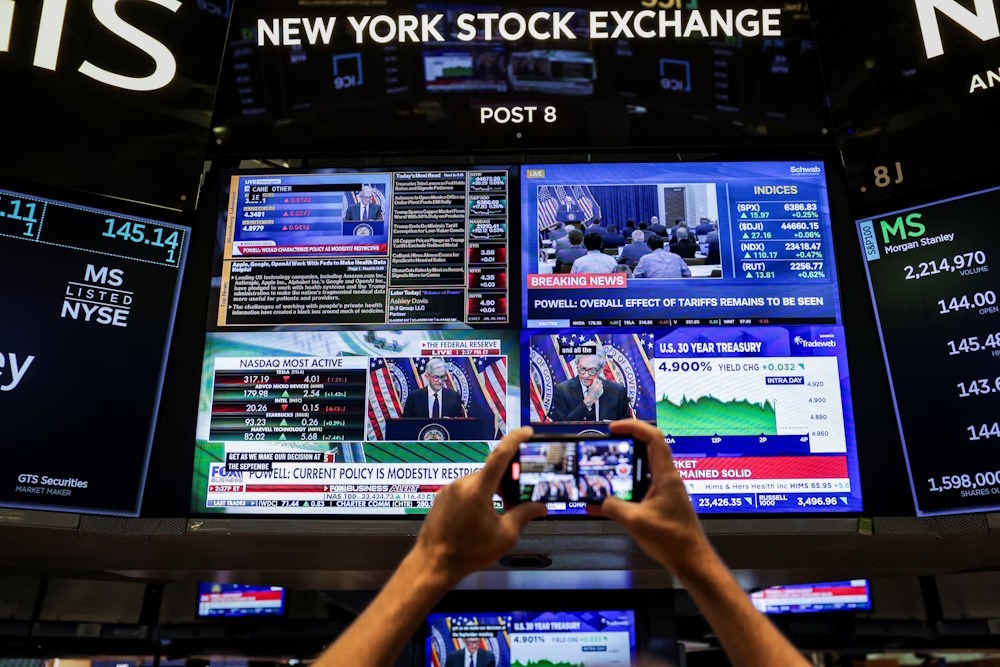
The Dow is scheduled to remain closed on Friday in recognition of the Independence Day holiday. Futures associated with the primary indices on Wall Street indicate a general upward trend, while South Korean equities are experiencing a recovery after a challenging week. This comes as expectations for a Federal Reserve interest rate hike later this month diminish in light of a lacklustre U.S. jobs report. Shares of Tesla’s Chinese suppliers have experienced a rally, coinciding with a stronger-than-anticipated growth in China’s services sector for June.
Dow futures increased following a June employment report that fell short of expectations, alleviating worries that the Federal Reserve would have to raise interest rates in the near term. By 03:11, the futures contract for the Dow had risen by 148 points, or 0.3%, the S&P 500 futures had climbed by 30 points, or 0.4%, and the Nasdaq 100 futures had advanced by 278 points, or 0.9%. The primary indices on Wall Street concluded the holiday-shortened trading week with varied results, as the benchmark 10-year U.S. Treasury yields remained unchanged and the rate-sensitive 2-year yields experienced a slight decline. Driving sentiment during the session was a Labour Department report indicating that while U.S. job additions in June fell short of expectations, the unemployment rate decreased to a one-year low of 4.2%. In conjunction with recent remarks from Federal Reserve Chair Kevin Warsh indicating a reduction in inflation risks, the anticipation of an interest rate hike by the Fed as early as this month has diminished. Market pricing for a July rate increase has decreased from 34% on Tuesday to merely 18% by the end of U.S. trading on Thursday, as noted by analysts at Deutsche Bank. “Moreover, just 30 [basis points] of hikes are now priced in by the December meeting, the fewest since the Fed meeting a couple of weeks ago when the dot plot surprised in a hawkish direction,” they added.
Asian equities experienced a rebound on Friday, buoyed by a dovish shift in Federal Reserve expectations and opportunistic buying in technology stocks. Investors re-entered semiconductor stocks, particularly following worries about the durability of substantial artificial intelligence infrastructure expenditures that had prompted widespread profit-taking earlier in the week. Among the most significant beneficiaries was Samsung Electronics, whose shares have surged following reports that Claude Code-parent Anthropic is contemplating plans to collaborate with the semiconductor manufacturer on the development of its own AI chip. This contributed to a rebound in the KOSPI in South Korea, which had been experiencing declines over the prior two sessions. Japan’s Nikkei 225 also advanced, along with Singapore’s STI.
In other developments, shares of Tesla’s Chinese suppliers experienced an uptick on Friday following the electric vehicle manufacturer reporting robust second-quarter delivery figures, which has fostered optimism regarding a possible recovery after two consecutive years of declining sales. Auto parts suppliers Ningbo Xusheng, Ningbo Tuopu, and Zhejiang Sanhua experienced increases ranging from 5% to 9% in trading within Mainland China. Tesla delivered a record 480,126 vehicles in the June quarter, supported by robust sales in Europe and slight growth in China. The company launched several lower-cost variants of its top-selling Model 3 and Model Y vehicles, which supported sales, particularly in the context of increasing global fuel prices. A refreshed Model Y also boosted overall sales of China-made vehicles, highlighting China’s significance as a major production and sales hub for the electric vehicle maker.
China’s services sector exhibited growth exceeding expectations in June, according to a private survey released on Friday. Robust domestic and international demand has sustained the sector’s expansion for over three years. The RatingDog services purchasing managers index declined to 54.1 in June from 54.4 in the previous month, yet surpassed expectations of 53.0. A reading above 50 signifies expansion, with the services index consistently positioned in growth territory since January 2023. The survey indicated an increase in new business, with growth observed in both domestic and international orders. Services exports, in particular, experienced their most rapid growth since October 2024. Higher input costs, driven by supply disruptions originating from the Middle East, prompted companies to increase their selling prices for the first time in four months.
Meanwhile, certain European leaders have started to entertain the notion that they may need to compensate Iran and Oman for the passage of ships through the Strait of Hormuz, according to a source. Citing individuals with knowledge of the situation, source reported that certain Gulf Arab officials share the perspective that a service fee may be implemented for the use of the crucial waterway, although this does not reflect the official stance of their respective governments. Nonetheless, it remains uncertain what specific types or amounts of fees nations would be prepared to endorse, according to sources, highlighting concerns regarding the implications these charges may have for international maritime law. Partially situated off the southern coast of Iran, the strait has emerged as a significant geopolitical flashpoint following Tehran’s effective closure of the conduit in response to a joint U.S.-Israeli assault in late February. Oil prices surged significantly following the closure; however, they have subsequently retreated to approximately pre-war levels after the signing of an interim peace agreement between the U.S. and Iran. This week, both parties engaged in indirect discussions regarding a permanent agreement in Qatar. According to a source, the upcoming meetings between U.S. and Iranian diplomats will be arranged at the “earliest possible time” after the funeral commemorations for Iran’s former Supreme Leader Ayatollah Ali Khamenei, who was killed by strikes at the onset of the war. Brent crude futures, the global oil benchmark, were last observed trading marginally higher, positioned around $72 a barrel. At one juncture after the commencement of the Iran conflict, the contract was valued significantly above $110 per barrel.