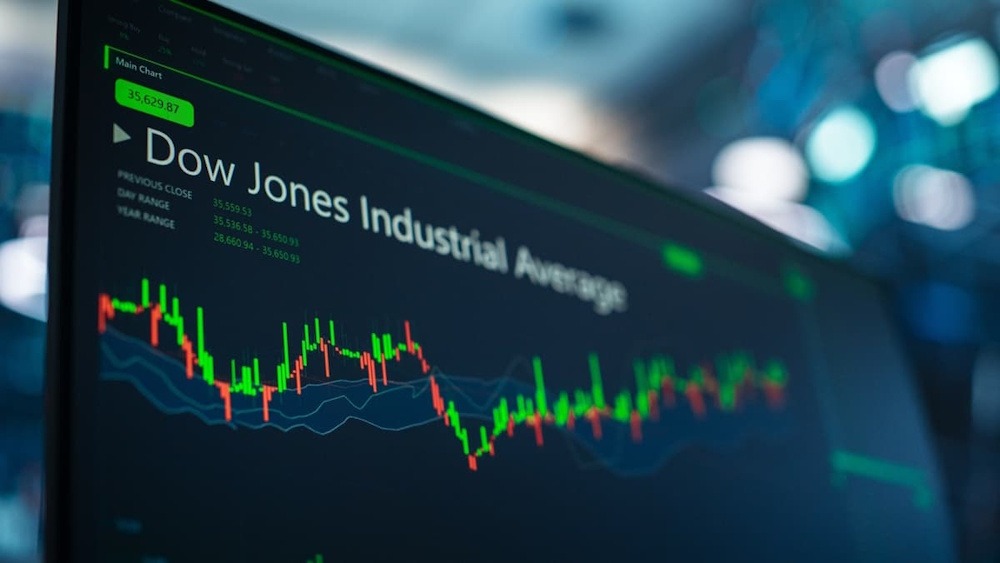
Dow Futures indicate an upward trajectory in response to renewed hostilities between the U.S. and Iran. Oil prices have declined slightly, yet they continue to hold above the levels seen prior to the recent attacks that have jeopardised a tenuous ceasefire agreement. Elsewhere, PepsiCo is set to announce its most recent quarterly results, with the conflict in Iran casting a shadow over the food and beverage maker’s prospects.
Dow futures experienced a modest increase on Thursday, following a period of volatile trading triggered by renewed hostilities in the Persian Gulf. By 02:53, the futures contract for the Dow had risen by 82 points, or 0.2%, while S&P 500 futures had edged up 21 points, or 0.3%, and Nasdaq 100 futures had gained 149 points, or 0.5%. The primary indices on Wall Street concluded the trading session with a varied performance on Wednesday. The blue-chip Dow Jones Industrial Average experienced a decline of 1.1%, while the benchmark S&P 500 saw a decrease of 21 points, equating to 0.3%. In contrast, the tech-heavy Nasdaq Composite recorded a modest increase of 0.2%. U.S. President Donald Trump’s assertion that he considered a framework ceasefire deal with Iran to be “over” negatively impacted sentiment, leading to a resurgence in oil prices and rekindling concerns about escalating inflation. However, resilience in technology stocks mitigated the effects of Trump’s statement. Shares of Nvidia advanced following a news report indicating that China would soon permit certain domestic purchases of the artificial intelligence semiconductor giant’s H200 chip. Traders were analysing the minutes from the Federal Reserve’s June policy meeting, which analysts noted conveyed a “fairly dovish tone on the monetary policy outlook,” even amidst ongoing concerns regarding price growth driven by energy factors.
The U.S. and Iran engaged in reciprocal strikes on Thursday morning, jeopardising an already fragile agreement to cease hostilities in the Middle East. U.S. Central Command announced that a recent wave of strikes targeted approximately 90 locations in Iran, encompassing air defence systems as well as missile and drone storage facilities. The U.S. military contended that the attacks were intended to impair Iran’s capacity to target commercial vessels in the Strait of Hormuz. Iran’s military responded with distinct attacks on what it characterised as U.S. military installations in Kuwait and Bahrain. The country’s paramilitary Islamic Revolutionary Guards Corps issued a warning regarding potential escalations, indicating that further attacks on American military sites in the Gulf could occur should Washington initiate additional strikes. Taken together with attacks earlier this week, the developments have raised concerns regarding the status of the interim ceasefire agreement established by the U.S. and Iran in June. Negotiations regarding a permanent agreement have become entangled in conflicts over the control of the Strait of Hormuz, Iran’s nuclear ambitions, and the hostilities between Israel and Hezbollah militants supported by Iran in Lebanon. Returning from a NATO summit where he indicated the conclusion of the ceasefire agreement, Trump stated that Iran had made contact, asserting that Tehran is eager to “make a deal so badly.” Iran, however, has remained silent regarding any new discussions.
Against this backdrop, Brent crude futures, the global oil benchmark, were last observed at just under $78 a barrel, compared to approximately $71 a barrel prior to the recent attacks. By 03:42, the contract had decreased by 1.0% to $77.26 a barrel. Oil prices have increased due to the potential for ongoing disruptions to shipping flows in the Strait of Hormuz, a crucial passage for approximately one-fifth of global oil and liquefied natural gas. Tanker traffic exhibited indications of an emerging recovery subsequent to the signing of the ceasefire agreement on June 17, which contributed to a decline in oil prices to approximately levels observed prior to the onset of the Iran war in late February. Shortly after the onset of the conflict, crude prices experienced a temporary spike, exceeding $110 per barrel. Markets and policymakers have expressed concerns regarding the implications of that spike on broader inflation. Much of the discussion has centred on whether central banks, including the Federal Reserve, will be required to increase interest rates to counteract the rise in prices. Expectations that the war could be winding down and oil supply chain snags were easing have contributed to recent hopes that inflation may eventually cool. However, the latest bout of attacks in the Gulf has created renewed uncertainty around the path ahead for prices.
On the earnings front, returns are expected from food and drinks manufacturer PepsiCo prior to the opening bell. In April, the group reiterated its annual targets for the second time this year, despite CFO Steve Schmitt informing investors that the “macroeconomic environment has become more volatile and uncertain because of ongoing geopolitical conflicts.” Concerns have emerged regarding the impact that rising energy and raw material costs, driven by the conflict in Iran, may have on global consumer goods companies, a sector already facing significant challenges due to extensive U.S. tariffs. Schmitt did not dismiss the potential for price increases to mitigate the elevated input costs, although he emphasised that this would be a measure of last resort for the company. Shares of PepsiCo have increased by approximately 0.2% year-to-date.
In June, consumer inflation in China showed signs of easing, whereas factory-gate inflation surged to its highest point in almost four years, underscoring the disparate price dynamics within the world’s second-largest economy. The consumer price index rose 1.0% in June from a year earlier, falling short of expectations for a 1.1% increase and decelerating from May’s 1.2% gain, according to official data released on Thursday. On a monthly basis, consumer prices decreased by 0.3%, contrasting with expectations for a 0.2% decline, following a 0.1% drop in May. Meanwhile, the producer price index increased by 4.1% year-on-year in June, aligning with economists’ projections and showing an acceleration from May’s 3.9% rise. The reading indicated the most significant annual increase since July 2022. Output prices declined across various sectors; however, this trend was somewhat mitigated by significant price increases in electronics, attributed to memory chip shortages driven by demand related to artificial intelligence, analysts indicated.