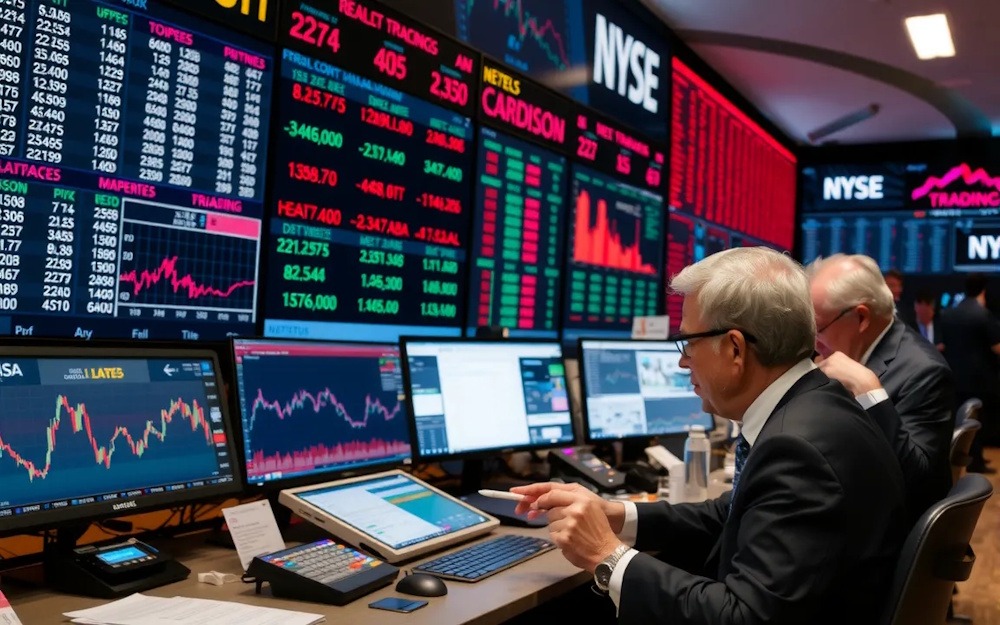
Dow Futures fluctuate around the neutral point, as investors brace for a series of significant earnings reports from the technology sector and a crucial decision regarding interest rates from the Federal Reserve. Alphabet and Microsoft are set to commence a series of significant earnings reports from the tech sector following the market’s close, while South Korea’s SK Hynix has announced a notable increase in its quarterly operating profit. Meanwhile, traders will be seeking insights into the Federal Reserve’s interest rate trajectory following the central bank’s most recent policy declaration.
Dow futures exhibited a mixed performance on Wednesday. By 04:02, the S&P 500 futures contract had increased by 10 points, or 0.1%, Nasdaq 100 futures had advanced by 173 points, or 0.6%, while Dow futures had decreased by 117 points, or 0.2%. The primary indices on Wall Street experienced gains in the previous session, with technology stocks notably driving a 1.18% increase in the Nasdaq Composite. A slew of recent artificial intelligence funding deals, along with Claude-maker Anthropic’s long-awaited IPO filing earlier this week, have contributed to alleviating concerns regarding substantial debt-driven expenditures on AI infrastructure. Investors continue to celebrate the AI funding announcements that hit the tape over the last 36 hours […] as these demonstrate that plenty of money still exists to underwrite the data center bonanza,” analysts wrote in a note. Simultaneously, approximately one-third of the quarterly corporate earnings season has elapsed. Results have largely been characterised as “decent” due to resilient demand, effective cost controls, and price increases, according to the analysts.
While the recent weeks have seen a temporary alleviation of concerns surrounding AI, a significant evaluation of the AI surge is set to occur following the market’s close. Alphabet, the parent company of Google, alongside software powerhouse Microsoft, is poised to dominate the upcoming post-market earnings announcements. This event may provide crucial insights into the AI expenditure trends among some of the globe’s largest corporations. Traders are particularly focused on identifying any indications of potential returns from the substantial investments made by Big Tech, which in some instances amount to hundreds of billions of dollars, in data centers and chips that support AI systems. In total, Alphabet, Microsoft, and Amazon – with its earnings report scheduled for Thursday after the market closes – are projected to allocate up to $600 billion in capital expenditures for the current year. Whether investors will embrace or resist an increase to those spending forecasts may be a pivotal question when the firms report this week. Earlier this month, an increase in spending plans by Facebook-owner Meta Platforms overshadowed otherwise strong results, leading to a decline in shares the following day. Meta’s stock has experienced a decline of over 4% year-to-date. “The more skeptical the market gets about AI returns, the harder it becomes to justify today’s pace of spending. Meta is a good example: the core business was shown to be strong, but with capex hitting nearly $34 billion in a single quarter, the market increasingly needs to see the ROI from that investment,” said Jake Behan.
To that end, SK Hynix reported a third-quarter operating profit that exceeded expectations on Wednesday, with the South Korean memory chip giant detailing plans to return a total of 100 trillion won to shareholders this year. Shares of the company surged more than 10% during trading in Seoul. SK Hynix’s operating profit for the three months to September 30 increased by 632% compared to the previous year, reaching 83.33 trillion won, significantly surpassing Bloomberg estimates of 77.5 trillion won. SK Hynix reported a remarkable increase in revenue, which surged by 328% to reach a historic 104.615 trillion won. Concurrently, net income experienced a substantial rise of 216%, amounting to 39.78 trillion won, as stated by the company. The company, recognised as one of the largest memory chipmakers globally and a significant beneficiary of the AI era, announced its intention to pursue shareholder returns amounting to 100 trillion won for the year.
Investor sentiment regarding AI debt deals and spending sprees may also be influenced by the critical Federal Reserve interest rate decision scheduled for Wednesday. The central bank is expected to maintain the current interest rates following the recent increase in borrowing costs, which marked the first adjustment since 2023 in September. Currently, there exists a probability of three out of four that the Federal Reserve will choose to increase interest rates during its concluding meeting of the year in December. Consequently, analysts have indicated that Fed Chair Kevin Warsh’s post-decision press conference will be subject to particularly intense examination. Yet do not expect unequivocal direction: Warsh has consistently refrained from providing forward guidance. Nonetheless, certain of Warsh’s peers at the Federal Reserve have suggested that additional rate increases could be required to address persistent inflationary pressures. For the technology sector, increased policy tightening could “raise the cost of funding the AI buildout while simultaneously raising the hurdle for the returns needed to justify it,” noted Behan from Direxion.
A key driver of rate expectations in recent months has been oil prices, which have soared largely due to disruptions to Middle East supplies following the outbreak of the Iran war in late February. The rise in crude has elevated the expenses associated with products such as diesel and petrol. Economists are currently monitoring for signs that these price increases, which can affect a range of areas from transportation costs to consumer fuel prices, are influencing other goods and services. While markets have responded positively to renewed diplomatic initiatives aimed at preventing further hostilities in Iran, the conflict has proliferated throughout the Middle East and exhibits minimal indications of de-escalation. Indeed, the U.S. has informed Gulf Arab countries to prepare for a brief, intense military campaign subsequent to the American midterm elections in November, as reported.